
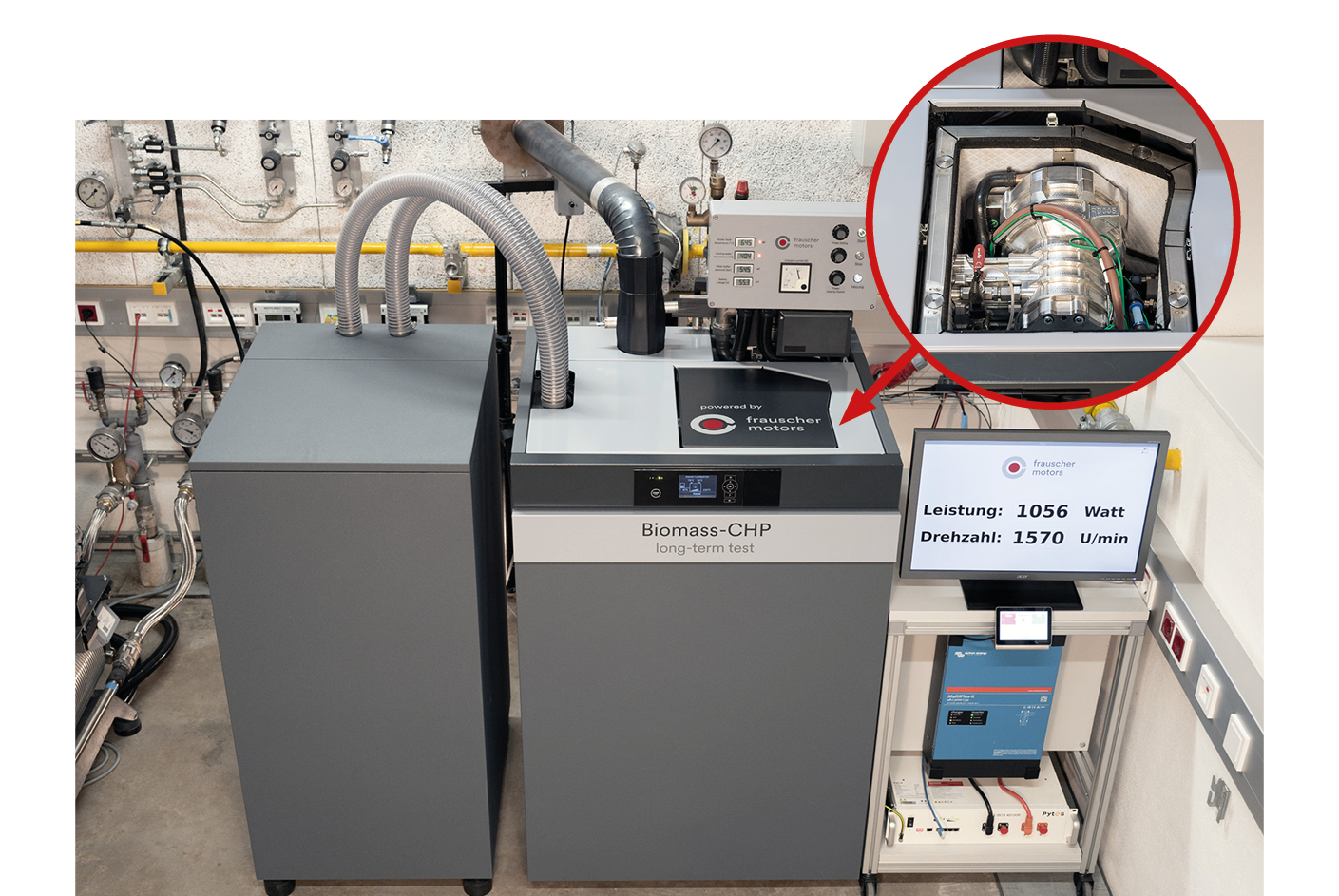
Pellet CHP pilot and demonstration plant.
Micro CHP: 10 kW of heat and 1 kW of electricity from the pellet boiler
Information provided by Frauscher Motors Research and Development
Electricity from solid biomass
Since we began our engine research in 2001, the use of our generators in biomass combustion has been a desirable goal that we have never lost sight of. We were therefore all the more delighted when, at the end of March 2026, we were able to successfully commission a suitably adapted pellet boiler with an integrated heat engine. After all, the decentralised generation of electricity and heat from wood not only offers a high level of sustainability but also maximum security of supply. The value of every pellet storage facility is thus significantly enhanced, particularly as a considerable energy reserve of heat and electricity can be easily stored and released as required. Supplementing the lack of photovoltaic energy during the winter months is playing an increasingly important role, as evidenced by the numerous enquiries from interested property owners.
The challenges: a reliable generator module and the interface with the combustion system
That it would take 25 years to achieve the goal was not foreseeable at the time, owing to the challenge that we first had to develop a suitable hot-gas engine alongside a new thermodynamic process. We attempted to outline the rocky road to that point in the last newsletter.
A second hurdle is posed by the specific characteristics of biomass combustion, which are far from meeting the requirements of a standardised heat engine. The ash content in the flue gases, the wide modulation range of modern boilers and the control of high-temperature corrosion are just a few examples. We analysed the weak points and developed solutions for reliable operation. For example, the installation of an automatic cleaning system for the heat exchanger surfaces, in conjunction with our innovative power maximisation (MPP tracking), ensures the highest possible electrical energy yield from the heat output of the combustion process.
When considering the challenges, it is also important to address the highly sensitive heating market. Here, availability and the cost of maintenance and servicing play a key role as factors affecting cost-effectiveness. We have therefore already designed our generator modules to a maintenance interval of 10,000 hours of operating time. The test rig on the test bench was intended to provide additional information on the long-term behaviour of the interface with the combustion system, in particular regarding the durability of the heater heat exchanger.
Retrofitting existing pellet boilers not recommended
Much to the disappointment of many prospective customers and users of pellet or wood gasification heating systems, we would like to strongly advise against fitting an existing boiler with our generator module. Apart from the loss of compliance status, such an intervention would have an impact on flue gas quality, potentially leading to the risk of deflagration or fire.
Our message is instead directed at manufacturers of biomass boilers, to encourage joint projects aimed at adapting the combustion system to the requirements of heat engines. The ratio of electricity to heat should be maximised in favour of electrical energy.
We offer the Gen70xx generator modules with an electrical output of 1.0 kW and a thermal output of 3 kW, including accessories. From late autumn, 5 kW electrical generator modules will be available; these are currently being tested on test benches under continuous operation. In addition to use in pellet-fired systems, the new generators are also designed for wood chip-fired systems.
St. Marienkirchen, May 2026
Signed Josef Frauscher